
FIELD REPORT: A timber agenda goes off the rails
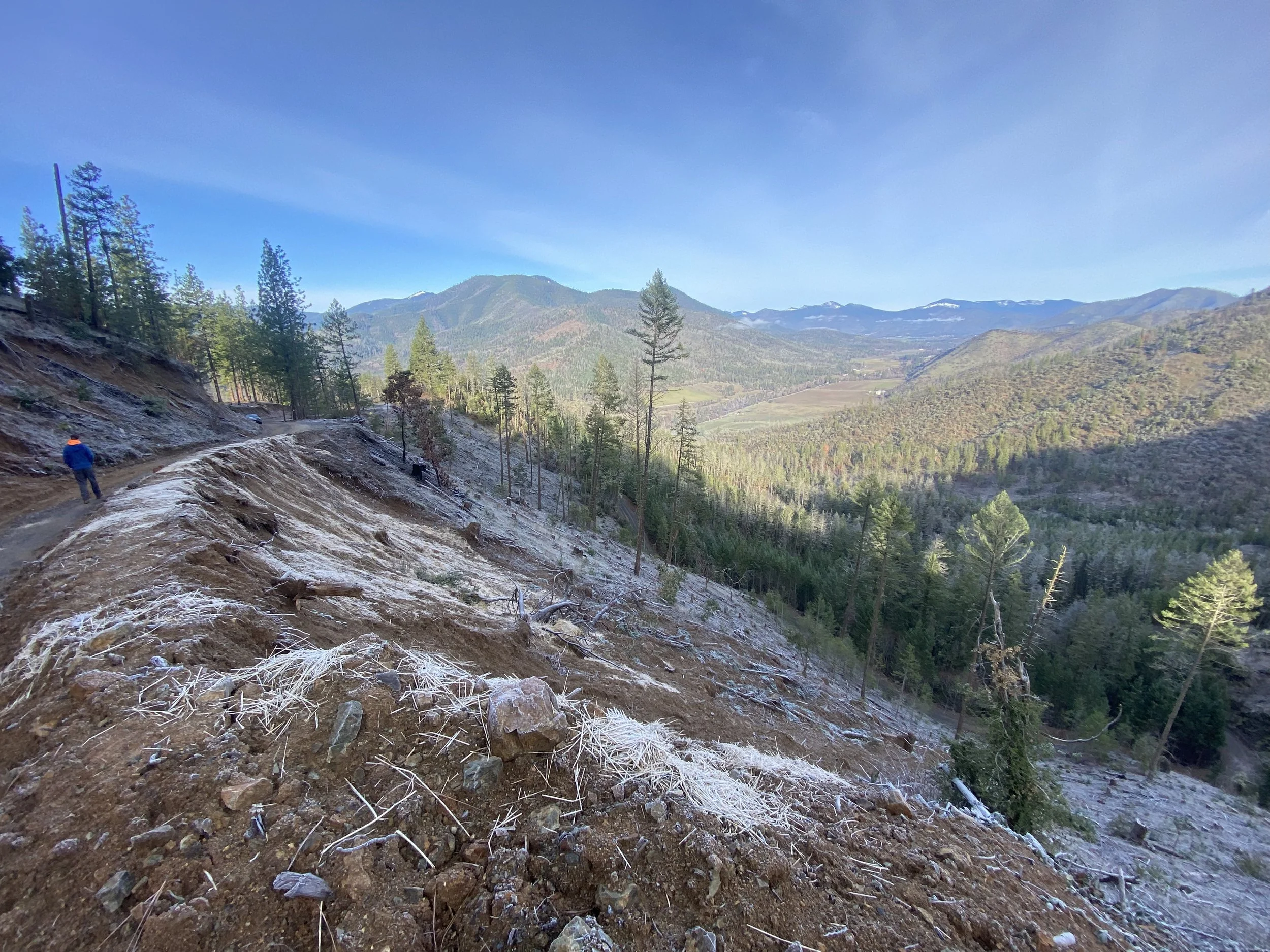
Image taken from the Boaz timber sale in the Applegate Valley, OR. Credit: Sydney Wilkins
KS Wild Field Report, 1/9/26
Boaz Timber Sale - Applegate, OR
Ashland Resource Area, Medford BLM
To the surprise of absolutely no one, timber planners in the Medford BLM have responded to the drought and climate-induced Douglas-fir die off in Southwest Oregon by clearcutting living green forests, blasting-in new mid-slope logging roads, slicking off riparian reserves, and logging and roading areas that the agency had sworn to protect as high priority habitat for Siskiyou Mountain Salamanders.
It doesn't have to be this way.
In many parts of southern Oregon, conscientious land managers in the zone of Douglas-fir mortality zone are attempting to address the effects of climate change, drought, insects, and fire exclusion on forest health and forest composition by restoring and encouraging oak woodlands and hardwood forests that provide habitat, are fire resilient, and are better equipped to deal with hotter and drier conditions.
But not the BLM. The Medford BLM has identified a real forest health crisis—namely the widespread death of lower-elevation Douglas-fir stands—and exploited that crisis to throw out the rulebook and clearcut Late Successional Reserves and Riparian zones.
We recently went into the field to give you a look at what was left behind after the BLM’s Boaz timber sale. Videos, photos, and stumps don't lie. And the debris torrents and slope failures that accompany the clearcutting and ground-based yarding speak for themselves.
These videos illustrate:
Denuded clearcuts
Trashed riparian reserves
Severe soil damage and sediment production
Poorly placed and engineered new logging roads
BLM "Best Management Practices" that consist of throwing a small about of straw on severe soil damage from yarding and road construction
The bottom line:
There is a way forward for forests landscapes that are getting hit hard by climate change and drought. We need to pull together to encourage and restore oak woodlands for the future and move the BLM past their single-minded conifer tree-farming paradigm.