
Lawsuit Seeks Endangered Species Protection for Two West Coast Pond Turtles
FOR IMMEDIATE RELEASE
September 9, 2026
PORTLAND, Ore.— The Center for Biological Diversity, Friends of the Columbia Gorge and Klamath-Siskiyou Wildlands Center sued the U.S. Fish and Wildlife Service today to force the agency to finalize Endangered Species Act protections for the northwestern and southwestern pond turtles.
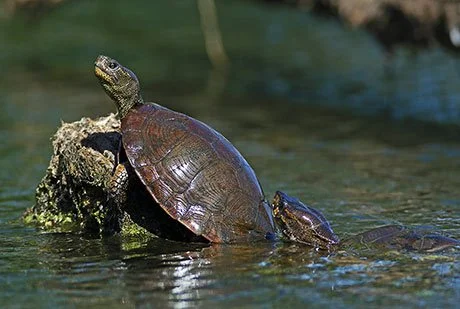
Western pond turtle basking in the sun on the Rogue River. Credit: Keith Kohl
The agency missed a legally required October 2024 deadline to protect the two pond turtle species after proposing to list them as threatened in 2023. Today’s lawsuit was filed in the U.S. District Court in Portland, Oregon.
“It’s inexcusable that it takes multiple lawsuits to get the Trump administration to protect imperiled wildlife like the northwestern and southwestern pond turtles,” said Meg Townsend, a senior freshwater attorney at the Center for Biological Diversity. “The longer these adorable turtles wait, the more endangered they become as the wetlands and forests where they live are lost to development, logging and wildfire.”
These turtles are two of only three freshwater turtles native to the Pacific coast of the United States.
“Pond turtle” is somewhat of a misnomer because although they do live in wetlands, these turtles also live in rivers and lay their eggs in adjacent uplands where they rely on open habitat like sandy banks or fields. When baby pond turtles hatch they are no bigger than a quarter.
Pond turtles were once abundant along the West Coast states of Washington, Oregon and California, but their numbers are decreasing. Current pond turtle populations are highly fragmented and face serious threats from habitat loss, predation of eggs and young by introduced species like largemouth bass and American bullfrogs, and the effects of climate change.
“After nearly two years of unlawful delay, the time has come for this federal agency to stop dragging its feet and comply with its legal obligations,” said Nathan Baker, senior staff attorney at Friends of the Columbia Gorge. “The government must take the next required step in ensuring the survival and recovery of the northwestern pond turtle. This iconic species is severely imperiled and needs all the help it can get.”
The scientific community previously recognized the two pond turtles as a singular species called the western pond turtle. Since 2017 the northwestern pond turtle and the southwestern pond turtle have been recognized as two distinct species, each of which is more endangered than the prior single western pond turtle species.
“Pond turtles are not only intrinsically valuable as living beings but also serve as key indicators of healthy aquatic and riparian ecosystems and nearby upland forests,” said Sydney Wilkins, conservation attorney at the Klamath-Siskiyou Wildlands Center. “These special creatures play an important role in the American West’s natural heritage and we want them to persist on the landscape.”
The Center petitioned the Service in 2012 to protect these western pond turtles under the Endangered Species Act because the best available science showed that they were declining swiftly toward extinction.
After the agency failed to make the required listing decision on its petition, the Center sued the agency in 2020 to force a determination, which resulted in the agency agreeing to submit its decision by October 2023.
On October 3, 2023, the Service proposed to protect the northwestern and southwestern pond turtles as threatened species due to various threats. To date, the Service has still not issued the required final rule.
Klamath-Siskiyou Wildlands Center is a nonprofit conservation organization headquartered in Ashland, Oregon, that works to protect the wildlands, wildlife, and biodiversity of the Klamath Siskiyou mountain ranges and southern Cascadian foothills of southwestern Oregon and northwestern California.
The Center for Biological Diversity is a national, nonprofit conservation organization with more than 1.8 million members and online activists dedicated to the protection of endangered species and wild places.
Friends of the Columbia Gorge is a nonprofit conservation organization with approximately 4,500 members that works to protect, preserve, and steward the Columbia River Gorge through conservation advocacy, litigation, land conservation, and community engagement. Friends safeguards the Columbia River Gorge and ensures that the natural wonders found there today will be preserved for future generations.