
Coastal Tailed Frog
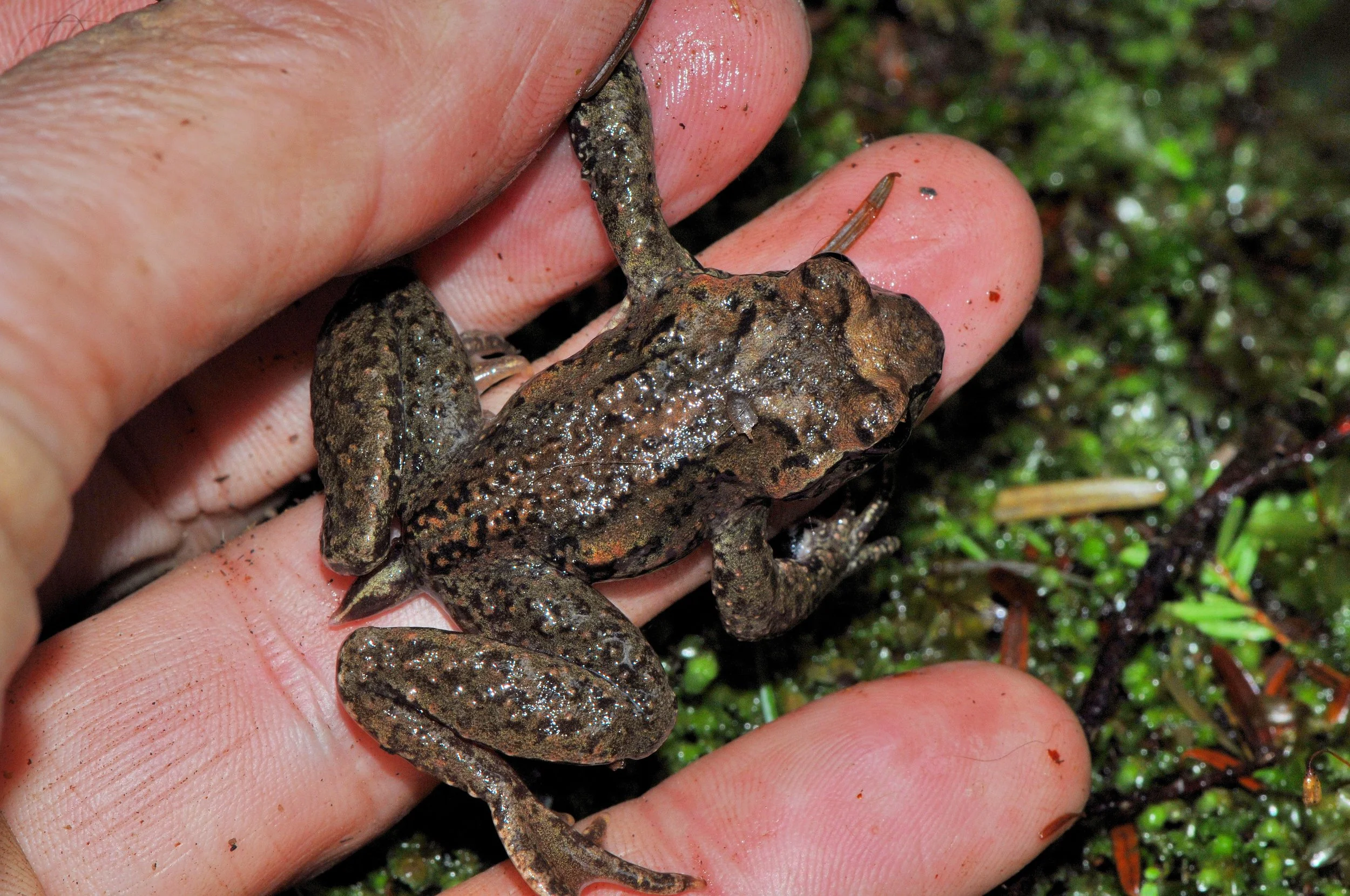
Coastal Tailed Frog (Ascaphus truei) Credit: Whatcom County Amphibian Monitoring Program (WCAMP)
The tailed frog is not hyper-adapted to just any aquatic habitat. It depends on old-growth forests and clear, fast-flowing, cold, mountainous streams only in the Pacific Northwest, an environment that would be hostile to many other amphibians. The frog is so peculiarly tailored to these fast-moving headwater streams that reproduction is vastly different than that of other frog species. For example, in response to their existence in fast-flowing streams, males evolved to use his “tail” to internally fertilize the female’s eggs, which she will then plaster to rocks with a sticky substance so they don’t flush down the stream. Once hatched, the tadpoles develop large, round mouths that act like suction cups with which they cling to rocks in rushing streams.
History
Not too long ago, the tailed frog has been split into two species: the Rocky Mountain tailed frog and the Coastal tailed frog. The tailed frogs’ closest relative resides in New Zealand, supporting the idea that these ancient lineages were separated by the movement of Earth’s tectonic plates. Neat! The subject of this blog is our local coastal tailed frog, Ascaphus truei. The coastal tailed frog is a living relic and has undergone relatively little evolutionary change over its approximately 230 million years of existence on this planet. It is deaf and mute (nary a ribbit!), and instead these frogs locate each other by feeling vibrations and sensing chemical signals.
Physical Description
The Coastal Tailed Frog (Ascaphus truei) is a small frog, roughly 1.5-2 inches long. It has a slender body with rough skin and a snout that tapers to the eyes, with a pale triangle marking between the eyes and the snout. It has vertical pupils, and its toes are only slightly webbed. It sports a dark green color to mimic the color of the forest floor. Males have a tail-like copulatory organ, and during mating season, they will show dark pads on the sides of their abdomens.
Fascinatingly, the tailed frog doesn’t have the vocal structures to make sound, so they have no call and make no noise.
Habitat and Distribution
The tailed frogs rely on cold, clear, rocky streams found in old-growth ecosystems. Each stage of their life cycle is adapted for quick-moving water. They need streambanks, logs, and springs for foraging and hiding and small boulders in waterways for egg-laying. They have a restricted range in the Pacific Northwest, with low reproductive rates as the larval stage lasts years. Due to their small size and need to be in or near water, they have limited dispersal capabilities.
Due to climate change and accelerated logging and clearcutting, the frog’s future could be bleak. If cold, headwater streams begin to warm due to increased sunlight exposure and sedimentation from logging, roadbuilding, or climate change, the frog will be unable to survive such shifts. A decade-long study recently confirmed just how detrimental old-growth logging is to tailed frog larvae and populations.
Maintaining the habitat conditions necessary for this little gem is not only important for the persistence of this primitive species, but also for the many benefits that healthy forested watersheds provide to us. Intact mature forests protect clean, cold, fast-flowing streams that provide a home for the tailed frog and supply us with clean drinking water and enhanced resilience to climate change. Demise to tailed frog populations can indicate habitat and ecosystem degradation from heavy logging, road construction, sedimentation, and warming temperatures. Because the habitat conditions needed by the frog closely overlap with those that support reliable drinking water, healthy fisheries, and resilient watersheds, this species serves as an important indicator of ecosystem health. Protections for the tailed frog and its habitat would safeguard both biodiversity and the critical values that healthy old-growth forests provide.
Conservation status
Currently, this frog benefits from neither state nor federal protections. KS Wild is actively advocating for the retention of old-growth forest ecosystems for all species, including the tailed frog. We will continue speaking up for this critter that has no voice (literally) and we will not let this tail become a tall tale.